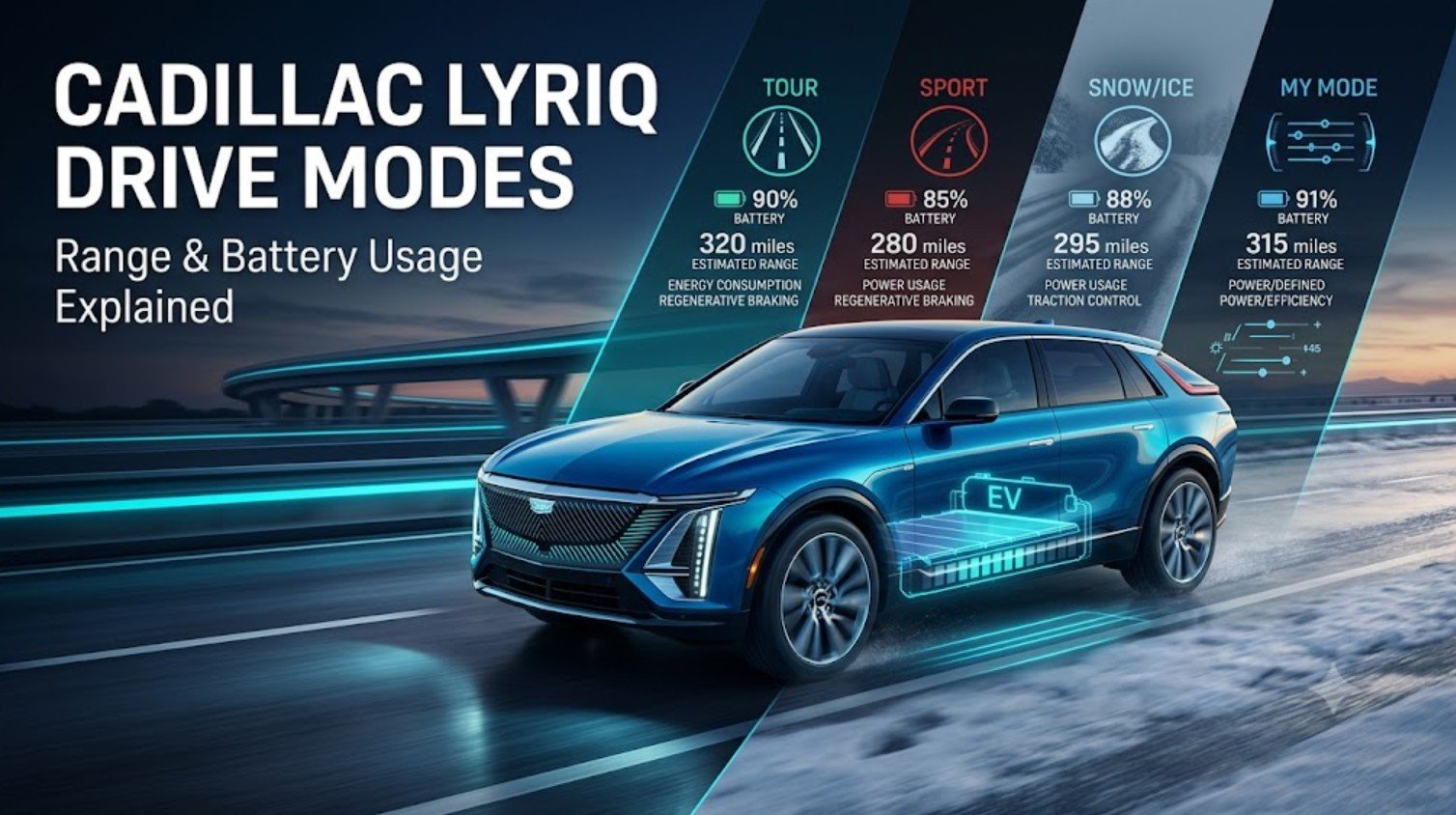
The Cadillac LYRIQ lets drivers adjust how the electric SUV responds through several selectable driving modes. Depending on the model and equipment, these may include Tour, Sport, Snow/Ice, and My Mode. Each setting changes aspects of the driving experience, such as accelerator response, steering feel, traction management, and other vehicle characteristics.
But do the driving modes in Cadillac LYRIQ offer different ranges or battery usages? Not in the form of separate official range ratings. Cadillac does not assign one EPA range to Tour and another to Sport or Snow/Ice. The selected mode can still influence real-world energy consumption because it changes how the vehicle responds—and that may affect how smoothly or aggressively it is driven.
Do LYRIQ Driving Modes Have Different Range Ratings?
Cadillac publishes range figures for specific LYRIQ configurations rather than for individual driving modes. For example, the 2026 single-motor rear-wheel-drive LYRIQ has an EPA-estimated range of up to 326 miles, while eligible dual-motor all-wheel-drive versions are rated at up to 319 miles. These figures can vary by configuration, but Cadillac does not provide separate ratings for Tour, Sport, Snow/Ice, or My Mode.
Selecting another mode also does not unlock or restrict a separate section of the battery. The same battery supplies energy to the vehicle regardless of which standard mode is active. What changes is the way the vehicle interprets accelerator input and manages driving characteristics. As a result, the mode may indirectly change consumption without altering the battery’s physical capacity.
EPA range estimates are produced through standardized laboratory procedures that include city, highway, aggressive-driving, hot-weather, and cold-weather testing. The results are adjusted and combined to create the figure shown on the vehicle’s fuel-economy label. The EPA does not normally present separate consumer range labels for every selectable mode.
That is why the estimated range shown inside the LYRIQ may change after a period of driving even though the official EPA figure remains the same. The vehicle can use recent consumption, driving habits, climate use, and operating conditions to provide a more relevant estimate for the current trip.
What Changes in Tour, Sport, Snow/Ice, and My Mode?
Tour mode is intended for normal everyday driving. Cadillac describes Tour or Normal modes as settings designed to support drive quality and economy, with predictable acceleration suitable for routine city and highway travel. For many owners, this will be the most balanced default setting.
Sport mode gives the vehicle a more responsive character. Accelerator inputs may feel sharper, while steering or other available chassis settings may become more performance-focused. Sport mode does not automatically consume a fixed amount of additional energy, but the quicker response may make rapid acceleration more likely.
| Driving mode | Main purpose | Possible effect on energy use |
|---|---|---|
| Tour | Balanced everyday driving | Usually supports smooth, predictable operation |
| Sport | More responsive driving feel | May increase use when paired with hard acceleration |
| Snow/Ice | Improved control on slippery surfaces | Not designed primarily as an efficiency mode |
| My Mode | Personalized driving settings | Depends on the selected settings and driving style |
Snow/Ice mode adjusts accelerator or torque response to help limit wheelspin on slippery roads. Its purpose is traction and control rather than maximum range. Although gentler torque delivery may encourage smoother acceleration, the cold temperatures and increased rolling resistance commonly associated with winter driving can still increase battery consumption.
My Mode allows the driver to personalize supported vehicle settings. Its effect on battery use depends on the selected combination and how the driver responds to it. A relaxed accelerator configuration paired with smooth driving may be efficient, while more aggressive settings and frequent acceleration can increase energy demand.
Which Driving Mode Uses the Least Battery?
Tour is generally the most sensible mode when efficiency is the priority because it is designed for normal driving and a balanced accelerator response. However, Cadillac does not promise that Tour will always produce a specific percentage improvement over Sport. Two drivers using Tour can achieve very different consumption figures if one drives smoothly and the other accelerates hard.
Sport mode does not constantly drain the battery simply because it has been selected. At a steady speed on the same road, the difference may be small. The larger effect usually appears when the more responsive accelerator encourages frequent bursts of power, higher speeds, or stronger acceleration.
Snow/Ice mode should be selected when conditions require it, not as a strategy for extending range. Its softer response can help drivers apply power more progressively, but snowy roads, low tire pressure, cabin heating, and cold battery temperatures may outweigh any benefit from gentler acceleration.
The best way to evaluate the modes is to compare energy use over similar routes. The LYRIQ’s vehicle-status information can show distance driven, total energy used, recent efficiency, and how factors such as climate settings and driving habits affected consumption. This provides more useful evidence than judging a mode after one short trip.
How Regenerative Braking Affects LYRIQ Range
Regenerative braking is separate from the main driving-mode selector. The LYRIQ’s One-Pedal Driving system slows the vehicle when the driver lifts off the accelerator, while Regen On Demand allows additional deceleration through a steering-wheel paddle. During regenerative deceleration, the electric motor converts some of the vehicle’s movement back into electrical energy and returns it to the battery.
Cadillac’s official One-Pedal Driving and Regen On Demand guide explains that these features can be used separately or together. They are particularly useful in traffic and on routes involving repeated slowing, where some energy that would otherwise be lost as heat through the friction brakes can be recovered.
Regeneration does not return all the energy previously used to accelerate the vehicle. Energy is still lost through aerodynamic drag, tire resistance, electrical conversion, and other mechanical processes. Smoothly maintaining momentum is therefore usually more efficient than repeatedly accelerating and then relying on strong regeneration.
Regenerative braking may also be limited when the battery is fully charged or at an extreme temperature. Cadillac advises that One-Pedal Driving and Regen On Demand are not recommended on wet, snowy, or icy roads, where conventional braking and careful control may be more appropriate.
What Influences Battery Usage More Than Drive Mode?
Driving speed is one of the largest influences on electric-vehicle range. Energy demand rises at higher speeds because aerodynamic resistance increases. A LYRIQ driven quickly on a highway may therefore consume more energy in Tour than one driven moderately in Sport.
Outside temperature and climate control also matter. Heating or cooling the cabin uses battery energy, while very cold or hot conditions can affect battery performance and regenerative braking. The EPA warns that cold weather, accessory use, and high-speed driving can reduce the real-world range of an electric vehicle.
Terrain, passengers, cargo, tire pressure, wheel choice, and road conditions can also change consumption. Climbing requires substantial energy, although some may be recovered while descending. Additional weight and low tire pressure increase the work required to move the vehicle.
Cadillac identifies temperature, terrain, vehicle load, and driving technique as important range factors. Owners seeking better efficiency should accelerate progressively, maintain moderate speeds, keep tires correctly inflated, avoid carrying unnecessary weight, and precondition the cabin while the vehicle is connected to a charger when appropriate.
Conclusion
Cadillac LYRIQ driving modes can affect real-world battery use, but they do not have separate published EPA range ratings. Tour is the most balanced choice for ordinary, efficiency-conscious driving. Sport may consume more energy when its sharper response leads to aggressive acceleration, while Snow/Ice prioritizes traction rather than range.
Driving style, speed, temperature, climate control, terrain, load, and regenerative-braking use usually have a greater influence than the mode name itself. The most accurate approach is to monitor the LYRIQ’s energy data over comparable trips and select the mode that suits the road conditions.
Frequently Asked Questions
Does Sport mode reduce the Cadillac LYRIQ’s range?
It can reduce real-world range when it encourages quicker acceleration or higher speeds. Cadillac does not publish a fixed range penalty for Sport mode.
Is Tour the most efficient LYRIQ driving mode?
Tour is the most appropriate general setting for smooth and balanced driving, but actual efficiency still depends on speed, weather, climate use, and driver input.
Does Snow/Ice mode save battery power?
Snow/Ice mode is designed to improve control on slippery surfaces, not to maximize range. Winter temperatures can still increase energy consumption.
Does One-Pedal Driving increase LYRIQ range?
It can recover energy during deceleration and reduce reliance on friction brakes. The benefit depends on the route, traffic, battery condition, and driving technique.