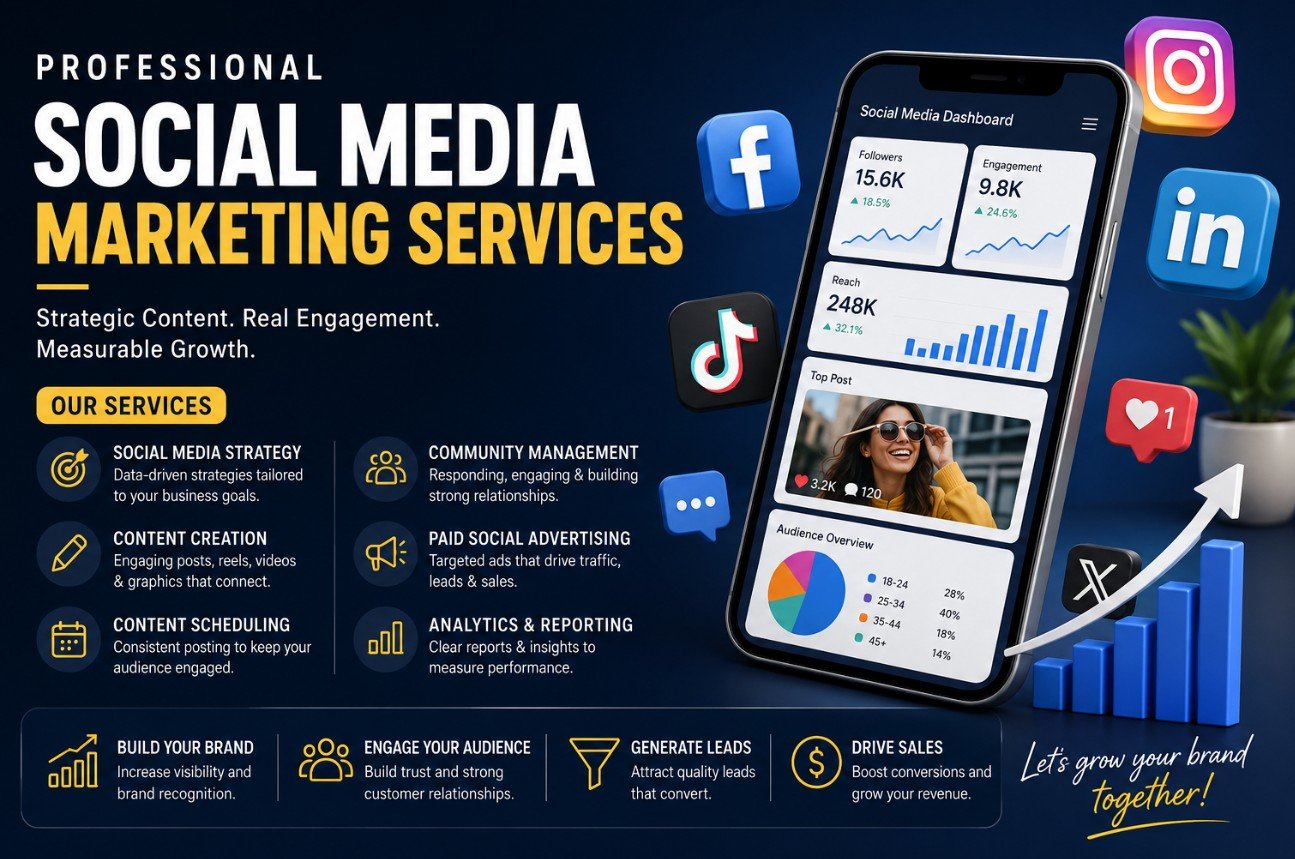
Social media has become a major part of how customers discover businesses, compare products, ask questions, and decide what to buy. But simply creating an Instagram, Facebook, TikTok, or LinkedIn account is no longer enough. Businesses need a clear strategy, useful content, consistent publishing, audience engagement, and reliable performance tracking. This is where professional social media marketing services can make a practical difference.
In 2026, effective social media marketing goes well beyond gaining followers or collecting likes. Businesses are using short-form video, creator partnerships, paid advertising, community building, social search, and detailed analytics to support measurable goals such as brand awareness, website traffic, qualified leads, and sales. The strongest approach connects these activities to a defined audience and business objective instead of publishing content without a clear purpose.
What Do Social Media Marketing Services Include?
Professional social media marketing usually begins with strategy. Before creating posts, a provider should understand the business, target audience, competitors, goals, and platforms that matter most. From there, services may include content planning, graphic design, Reels and short-form video, captions, content calendars, scheduling, paid advertising, community management, influencer outreach, and performance reporting. The exact combination should depend on what the business is trying to achieve rather than using the same package for every client.
Content creation is only one part of the process. A complete service also considers what happens after people see a post. For example, a company may use educational videos to attract new viewers, community management to answer their questions, and retargeting ads to reach people who previously visited its website. Analytics then show which topics and campaigns are producing meaningful results, allowing the strategy to improve over time instead of relying on assumptions.
A good provider may also adapt content for different platforms. A professional LinkedIn post aimed at business decision-makers will usually need a different tone and structure from a TikTok video designed for younger consumers. Platform-specific content often feels more natural and gives the audience a better reason to engage.
How Can Social Media Marketing Increase Brand Awareness and Engagement?
Brand awareness grows when the right people repeatedly see useful and recognizable content. Consistent visual identity, clear messaging, educational posts, customer stories, and short-form videos can help a business become easier to remember. The aim is not to publish as often as possible but to create content that gives the audience a reason to stop, watch, save, share, or visit the business profile.
Engagement matters because social platforms are interactive. Comments, shares, saves, direct messages, and replies can reveal what customers care about. A business that responds thoughtfully can build stronger relationships than one that only publishes promotional material. Community interaction also provides useful feedback about customer questions, objections, and preferences, which can later influence content, products, and customer service.
Authenticity is increasingly important as audiences become more familiar with polished advertising and AI-generated content. Behind-the-scenes videos, employee perspectives, customer experiences, expert explanations, and real product demonstrations can often make a brand feel more credible. Strong social media marketing therefore balances professional presentation with content that still feels human and relevant.
How Do Content, Paid Ads, and Community Management Work Together?
Organic content, paid advertising, and community management perform different roles. Organic posts help develop brand identity, educate followers, and build long-term relationships. Paid social advertising allows businesses to reach specific audiences more quickly based on location, interests, behavior, demographics, or other platform targeting options. Community management then supports conversations after people interact with the content or advertisements.
These activities are usually stronger when connected. A company might publish an organic video explaining a common customer problem, promote the strongest-performing version through paid ads, and then respond quickly when potential customers comment or send messages. Retargeting can later reach people who watched the video, clicked through to the website, or showed interest but did not convert.
Businesses using Meta advertising can choose campaign objectives based on outcomes such as awareness, traffic, engagement, leads, or sales. The official Meta Ads guidance explains how campaign objectives align advertising delivery with specific business goals. Choosing the right objective is important because a campaign optimized for video views is not the same as one designed to generate leads or purchases.
Paid advertising should also be tested rather than treated as a one-time setup. Different hooks, videos, headlines, audiences, and landing pages may perform very differently. Regular optimization helps identify which combinations provide better results and where advertising budget is being wasted.
Which Social Media Metrics Actually Matter for Business Growth?
Social media reports can contain dozens of numbers, but not every metric deserves equal attention. The right KPI depends on the business objective. For a brand-awareness campaign, reach, impressions, video views, and audience growth may matter most. For an engagement strategy, comments, shares, saves, replies, and engagement rate provide better insight into whether people actually value the content.
Lead-generation and ecommerce campaigns require deeper measurement. Useful metrics may include link clicks, click-through rate, form submissions, cost per lead, conversion rate, customer acquisition cost, purchases, revenue, and return on ad spend. A post receiving thousands of likes may still provide little business value if it produces no qualified traffic or conversions.
| Business Goal | Useful Metrics |
|---|---|
| Brand awareness | Reach, impressions, video views |
| Engagement | Comments, saves, shares, engagement rate |
| Website traffic | Link clicks, CTR, website sessions |
| Lead generation | Leads, cost per lead, conversion rate |
| Sales | Purchases, revenue, CPA, ROAS |
| Community growth | Relevant followers, replies, active users |
Reports should also explain why performance changed. Good social media analysis does not simply show that reach increased by 20%. It examines which content formats, topics, posting times, campaigns, or audience segments contributed to that change and what should happen next.
How Should You Choose a Social Media Marketing Provider?
Start by looking for a provider who asks about your business goals before discussing the number of posts. A company focused on lead generation requires a different strategy from a restaurant seeking local awareness or an ecommerce brand trying to increase sales. The provider should be able to explain which platforms and content formats make sense for your audience and why.
The scope of work should also be clear. Confirm how many posts, videos, Stories, captions, and revisions are included, whether scheduling is handled, and whether community management or paid advertising is part of the package. Ad spend should normally be listed separately from the management fee so there is no confusion about where the budget is going.
Ask how success will be measured. A reliable provider should be comfortable discussing KPIs such as engagement, traffic, leads, conversion rate, and revenue rather than promising guaranteed virality or a specific follower count. Social media performance depends on many factors, including the offer, competition, creative quality, audience, advertising budget, and market conditions.
Ownership and access are also important. Businesses should generally retain control of their social accounts, advertising accounts, tracking systems, and core brand assets. Clear approval processes, reporting schedules, response times, and responsibilities can prevent misunderstandings once the work begins.
Conclusion
Professional social media marketing services can help businesses turn social platforms into structured marketing channels rather than places where content is posted without direction. Strategy, content creation, short-form video, advertising, community management, and analytics work best when they support the same business goal.
The right provider should understand your audience, create platform-appropriate content, measure meaningful results, and adjust the strategy based on performance. Businesses should focus less on vanity metrics and more on whether social media is improving awareness, relationships, qualified traffic, leads, or sales.
FAQs
What are social media marketing services?
They are professional services that may include social strategy, content creation, publishing, paid ads, community management, influencer marketing, and analytics.
How much do social media marketing services cost?
Pricing varies widely based on the number of platforms, content volume, video production, advertising, community management, and reporting requirements.
Which social media platform is best for business?
It depends on the target audience and business model. LinkedIn can work well for B2B companies, while Instagram and TikTok are often stronger for visual consumer brands.
How long does social media marketing take to show results?
Paid campaigns can generate data quickly, while organic audience growth and brand trust usually develop over a longer period. Results depend on strategy, content quality, consistency, and market conditions.